| Release List | Reviews | Price Search | Shop | Newsletter | Forum | DVD Giveaways | Blu-Ray/ HD DVD | Advertise |

| Reviews & Columns |
|
Reviews DVD TV on DVD Blu-ray International DVDs Theatrical Reviews by Studio Video Games Features Collector Series DVDs Easter Egg Database Interviews DVD Talk TV DVD Talk Radio Feature Articles Columns Anime Talk DVD Savant HD Talk Horror DVDs Silent DVD
|
 DVD Talk Forum |
|
|
| Resources |
|
DVD Price Search Customer Service #'s RCE Info Links |
|
Columns

  

|
 |
Savant Essay: |
|
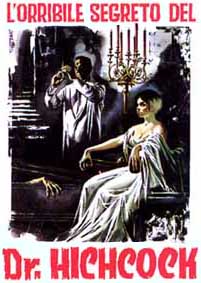
An essay that first appeared in the online Images web-zine in 1997. It has since been reprinted as a chapter in Alain Silver and James Ursini's The Horror Film Reader, Limelight, NY. As of this writing, L'orribile segreto del Dr. Hichcock is available in Region 1 only in gray-market versions. A beautiful Region 2 Medusa DVD is now avalable in Region 2, but it has no English track or subtitle options. |
Midnight. A fog-shrouded cemetery. An old man labors over a half-dug grave. From the shadows creeps a mysterious top-hatted stranger. He abruptly clubs the gravedigger senseless and then pries open the coffin, revealing the pallid blue face of the female cadaver within ....
So far, so good. We're in familiar territory, with familiar questions about this intruder's purpose. Does he need the cadaver for medical research? Doctors forced to turn criminal are often quite sympathetic in horror films. Is he a mad scientist seeking to create a living monster from dead tissue? No shock there -- that revelation wouldn't cause the average school kid to blink twice. But this ghoul has another agenda entirely. He leans purposefully over the opened coffin, runs his fingers over the face of the deceased, and begins to fondle and caress its presumably rigor-mortised torso -- ugh! Even director Riccardo Freda fades out on that one!
The outrageous central concern of The Horrible Dr. Hichcock has never been considered appropriate material for any film openly advertised and exhibited to the public, horror or otherwise. That a film about the frustrated passions of a necrophiliac could even be released in 1962 is a censorial mystery in its own right -- or, perhaps a clear testament to the way horror films were officially ignored on every cultural level back then. 1 Did censors perhaps not know what was going on? Did they bother to even watch the film?
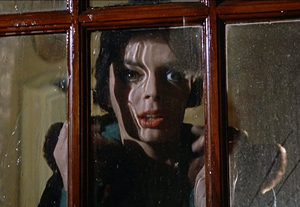
Of all Italian horror from the classic era, 1957-66, Horrible has perhaps the wildest reputation. For all the purported freedom of the screen, horror films unwilling to base their themes in conventionally conservative fantasies today have as hard a time as ever reaching a mass audience. Films with conceptually challenging ideas, such as The Stranglers of Bombay and Peeping Tom can still be difficult to discuss outside of cult horror circles, even forty years after their release.
Also retaining its power to disturb, the unconventionally aberrant Horrible is well worth examining, from its peculiar place in the ranks of Italo Horror to its bizarre, macabre, yet completely reasonable take on sexual relationships.
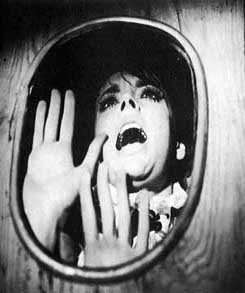
The central focus of Horrible is the spectacle of the insane Bernard Hichcock wrestling with, and then embracing his own demons. He's a perverse hero undeterred from unspeakable goals. These he pursues with unrepentant delight, largely uncriticized by any moralizing imposed by the filmmakers: this is in no way the sort of "responsible" film that proffers sordid content while pretending to condemn it. What is also atypical is that the actual "corpse-molesting" is represented partly from Hichcock's point of view, with the audience identification techniques commonly associated with Alfred Hitchcock. Unlike the fleeting glimpses of necrophiliac tableaux presented in Edgar G. Ulmer's The Black Cat or Roger Corman's The Tomb of Ligeia, here the viewer is allowed an identification with the hero's perverted behavior, an obsession treated as if it were the pinnacle of erotic stimulation. Roman Vlad's swooning violin score signals the onset of Hichcock's unnatural cravings, and shafts of hallucinatory scarlet light erupt whenever he comes close to consummating his "unnatural lust."

Italian horror in the early 1960s had a unique set of commercial compromises, aesthetic characteristics that are clearly evident in Horrible. Precise camerawork and atmospheric visuals receive a great deal of attention, but more often than not the actors are left to fend for themselves. The experienced Flemyng expands his character with a broad range of neurotic behaviors, but the young Barbara Steele relies on mechanical hand wringing to express her nervous state. In one baffling instance, Steele stares vacantly at the camera for a couple of seconds, as if she thought she were performing a run-through and not a final take. Both Ms. Steele and actress Harriet White are on record as having little memory of being given much direction from Italo horror directors Freda, Bava, or Margheriti, who were probably under crushing time constraints just to get scenes shot at all. Writer Ernesto Gastaldi, in his interview with Tim Lucas in Video Watchdog 2 explained that Freda was so concerned about the tight shooting schedule that he simply eliminated pages of dialogue scenes that established motivations for the characters. With little character exposition to aid them, viewers must look to subtext to decipher Horrible's disturbing images.
It was not uncommon in these Italo horrors to see English-sounding pseudonyms substituted for the real names of the Italian actors and artists. The Italians were apparently more than willing to hide behind ersatz English identities, the better to resemble the internationally successful Hammer films. Director Riccardo Freda first used his "Robert Hampton" alias on Caltiki, il mostro immortale (with second-string English actor John Merivale for its lead), a ploy which helped that film get its American release through Allied Artists. For Horrible, anglicized names were used throughout:
Multiple titles were employed to court multiple markets. The original Italian release L'orribile segreto del Dr. Hichcock became two variant versions in export: The Terror of Dr. Hichcock (England), and The Horrible Dr. Hichcock (U.S.). 3 The two latter versions are available here in the U.S.A.; the American print is about a dozen minutes shorter, and marginally tamer, than the English. 4
The absence of explicit nudity, violence and gore kept the export versions of Horrible from suffering the huge censor cuts that gutted many later European productions. A major part of the frustration/fascination of Italo horror for Yank viewers is looking at Castle of Blood or Nightmare Castle and trying to imagine what additional forbidden content comprised their original versions, Danse macabre (5 minutes longer) and Amanti d'oltretomba (32 minutes longer!). Fortunately, most of The Horrible Dr. Hichcock actually seems to be intact.
Or is it? Unless one can see a rare quality print that retains its original lush photographic presence, Horrible's appeal is greatly diminished. 5 Assaying the pale, pan-scanned video cassette versions that have survived the years amounts to an act of faith in the accolades of critics who saw the original on theater screens.
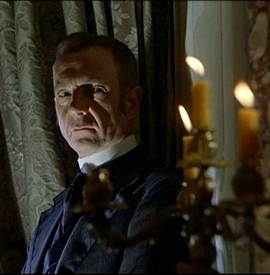
Actually, contemporary criticism still comprises some of the best writing on The Horrible Dr. Hichcock. Raymond Durgnat's response went beyond his admiration for the hypnotizingly exciting Barbara Steele to focus on Freda's direction in the funeral scene, where sunlight shining through misty raindrops produces a painfully beautiful rainbow effect (here is where we can assume Durgnat saw a pristine copy of the film). Durgnat points out how death and beauty are effortlessly joined in one simple image, an equation he applies equally to Ms. Steele's screen persona. Fusing the concepts of desire and death, she herself has become a sort of morbid fetish-object. 6
The Horrible Dr. Hichcock also attracted the attention of surrealist critics, who see the title character as a pioneer, a hero "on the trail of the marvelous" in territory untouched by moral conventions.7 The surrealists love Horrible for its lack of concern for conventional cinematic realism. They especially love movies where the distinctions between "real" and "dream" filmic content are blurred (Peter Ibbetson), or, better yet, undetectable (Belle de Jour). The liabilities of a narrative that often makes no sense, or where simple day and night are sometimes indistinguishable 8 become plus factors: for surrealists, delirious, illogical dislocation is an end unto itself. The white-tiled surgery that suddenly and unaccountably glows bright red, and Hichcock's "unholy lust" that distorts his face into a horror-mask, are poetic effects totally without narrative rationalization.
In its initial review the Monthly Film Bulletin was amused by the movie's play with familiar Alfred Hitchcock film conventions, which for them, along with the humorous anglicized names, indicated a lively sense of humor at work. From Rebecca comes the basic "haunted bride" plot, complete with first wife's portrait and conspiratorial housekeeper. Suspicion's poisoned glass of milk is a direct quote. The rainy funeral is visually reminiscent of a scene in Foreign Correspondent. Most telling is the very Vertigo- like color wash stylization that heightens Hichcock's delirium: a comparison of the obsessive romantic/sexual agendas in The Horrible Dr. Hichcock and Vertigo suggests a more serious thematic relationship between the films than the MFB's "camp parody" conclusion would admit. 9 There are similarities in the obsessive manias of Scotty Ferguson and Bernard Hichcock that would seem to beg further investigation. Even a cursory analysis reveals that Freda and Gastaldi's lowly horror film goes far beyond simply imitating the master of suspense, to propose a radical sexual theory of its own.
Bernard Hichcock's outrageous sexual manipulation of wives Margaretha and Cynthia, like Scotty Ferguson's obsession, is an expression of the masculine drive for an unattainable sexual ideal. This selfish and often destructive mania is easily recognizable even in contemporary American culture. There is at present a booming trade for mail-order brides from poor developing countries, chattel for men presumably seeking cooperative women uncomplicated by "liberal" American ideas. Is that not equally as chilling as Hichcock's scheme? Some of these men presumably seek compliant sex partners who can be dominated completely -- is that not Hichcock's goal? Hitchcock's desire is for the perfect love object, not a companion. And his personal solution carries a certain logic. Would not a corpse for a lover be the perfect non-complaining, totally compliant partner? -- an object, a victim, a scapegoat, a passive receiver of affection and abuse, one incapable of spoiling the selfishness of the sexual act with an agenda of its own? It's an ugly concept, but a completely believable one.
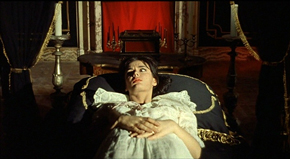
The Horrible Dr. Hichcock transcends its exploitative title by presenting a bizarrely accurate assessment of sexual alienation. The strange irony is that Hichcock's relationship with his first wife Margaretha is, up to a point, "conventionally conservative" -- i.e., the male has the active desires, and the female role is to be willing to indulge them.
One needn't be a Victorian to understand the sexual politics at work. The bizarre game in the secret black velvet "love room" also makes logical cultural sense. With the advent of anesthesia, Victorian childbirth became the exclusive business of male doctors. Because the ideal female was supposed to be sheltered from such unpleasantness, it was assumed she would welcome the opportunity to not even be a conscious participant in the event. Under those conditions it would seem to follow that women consenting to sleep through the animalistic, painful and messy experience of child-birthing might also opt out of having to be present for the messy, animalistic and often humiliating sex experience. After all, this was a society where women were supposed to want sex not for themselves but only as a way of pleasing their husband/masters. The brief glimpse we are given of the doomed Margaretha shows her an avid participant in her hubby's "funeral" game, radiant in the selfish/unselfish knowledge that she and she alone can help him reach his sexual ideal. Cannot women identify with her unconditional surrender to the will of her mate? When does compliant devotion become sexual slavery?
Margaretha's return from the grave introduces a second relationship-based dynamic, a bald lift from Rebecca but distilled here to its essence. As competitors for Bernard's affections, Cynthia and Margaretha seem to function even more obviously as possessions of matrimony, as objects and not women. Before, Margaretha surely considered her domestic relationship a viable one: he fulfilled her needs, she his. Now, transformed by the serum (and/or a premature burial) into an insane hag, she has become a Dorian Gray- like personification of the sick truth of her marriage. The only communication between these two women is Margaretha's vicious gloating over the fact that Bernard has chosen her over Cynthia. Only one of them is a knowing partner in her husband's game, but neither is anything more than a sexual pawn in an equation that values only Bernard's needs and desires.
How can true honesty be achieved between beings with alien sexual agendas, conditioned from childhood to entice and possess the other through deception? After all, no matter what either wife accepts about the extent of Bernard's obsession, neither satisfies his "forbidden desires," which are finding expression elsewhere -- on the job, in the neighborhood cemetery ... those pesky perverted men, anyway! -- always pursuing sensation instead of relationships! In her dog-like consent to "the game," Margaretha will never know her husband's desires for the tyranny they truly are. Cynthia's one unwilling experience in "the game", apparently with insufficient serum to render her completely unconscious, creates a macabre situation that rather nastily compares loveless matrimonial sex to surgery without anesthesia!
The real horror in the film lies in the crimson spectacle of the helpless Barbara Steele experiencing the full extent of her husband's secret rapture -- visualized when his horrifying face, engorged and distorted, materializes demon-like from behind the black lace of her four-poster canopy. In universal terms that terrifyingly unexplainable bloated apparition represents the menacing sexual stranger that, to a woman in doubt, any male can suddenly resemble.
Footnotes:
1. Contrast that indifference with the furor that caused the cancellation of the release of Snuff in the middle '70's, sight unseen, because of publicity implying that real snuff murders took place in the film. Ever since Night of the Living Dead (1968), American reviewers have been quick to seek out new horror films to condemn.
Return
2. Lucas, Tim, "What Are Those Strange Drops of Blood in the Scripts of Ernesto Gastaldi?", Video Watchdog #39, 1997, 34-36.
Return
3. Hardy, Phil, editor, The Encyclopedia of Horror Movies, Harper & Row, New York, 1986,ISBN 0 06 096146 5, x,149. Hardy also refers to The Terrible Secret of Dr. Hichcock and Raptus (which writer Ernesto Gastaldi identified to Tim Lucas as a working title) as variant titles.
Return
4. The actual differences between Terror and Horrible: The English Terror begins with a full title sequence against black. Melodramatic title music is at one point amusingly interrupted by one of Ms. Steele's bloodcurdling screams, heard over pitch black. The film then begins with the graveyard scene. Horrible uses the graveyard scene as pre-credit sequence and truncates the English title sequence, substituting the main title card for an ugly replacement. Horrible has at least one extra off-camera
line dubbed in: "Yes, but you must admit the doctor is a bit strange himself, isn't he!" is added to Margaretha's burial scene, just before Jezebel the cat is clearly thrown on her coffin. In Horrible fades have been imposed on most scenes, retaining Terror's dialog but dropping entrances and exits and in general spoiling the pace and atmosphere of the whole show. Freda originally cut pointedly from Bernard holding his syringe aloft in the clinic, to him identically holding his sex-game syringe later at home; Horrible ruins the transition by inserting an unnecessarily literal shot of a homeward-bound carriage in between. When Bernard dashes into the rainstorm in pursuit of the piano-playing phantom, Horrible omits a nice sequence of him returning to the house and confusing a lightning-lit white curtain for the specter, before finding the unconscious Cynthia in the garden. At the conclusion, the young intern's long climb into Hichcock's window is shortened by almost a minute. No key sex scenes are actually missing, but most are abbreviated with the addition of the early fadeouts: in the graveyard, in the Funeral Game Room, and in the morgue, Hichcock's attentions to various corpses linger a bit longer in Terror. Contrary to expectation, there is neither nudity nor graphic footage in the longer English cut.
Return
5. A recipe: Take an Italian production of any quality, ineptly dub it into English, make blearily colored, grainy 35mm prints. Chop these up with clumsy splices to remove offending nudity or gore, dupe these prints again for television, cropping off their original widescreen compositions, let these 16mm copies fade on a shelf for twenty years while local television stations censor them even further. Then hastily transfer the result to fuzzy video, distorting their already tortured soundtracks. Finally, screen the video to your friends while trying to explain its artful worthiness! .... For American fans unable to see museum showings of rare prints, Italo Horror is a cinema that oftentimes "isn't there". (Note August 8, 2009: this paragraph indicates the unavailability of good video on Eurohorror in 1997 ... although copies of many classics remain out of reach, twelve years of excellent DVD releases has improved matters considerably.
Return
6. Durgnat, Raymond, Films and Feelings, The M.I.T. Press, Cambridge, Massachusetts, 1967, 53, 147-148.
Return
7. Matthews, J. H., Surrealism and Film, The University of Michigan Press, Ann Arbor Michigan, 1971 ISBN 0 472 64135 2, 23-28, 149. Here Horrible keeps cozy company with the likes of King Kong and the works of Luis Buñuel.
Return
8. A typical example: on the night of Cynthia's arrival, housekeeper Marta says she will remove her insane sister from the house "tomorrow'". The very next evening, Marta says she sent her sister away "yesterday".
Return
9. After seeing the spectacle of Horrible's Flemyng in the throes of his obsession, the nervous anguish and blind mania of Vertigo's James Stewart seem perverted in a disturbingly similar way
Return
10. (Note August 8, 2009: Savant thanks collectors and avid students of L'orribile segreto del Dr. Hichccock Peter Lukac and Robert E. Seletsky for additional information and revelations about this shared object of cinematic interest.
Credits:
Barbara Steele
Robert Flemyng in
THE HORRIBLE DR. HICHCOCK
Produced by: Louis Mann, for Panda
in Technicolor (r)
with: Montgomery Glenn
Teresa Fitzgerald
Harriet White
Original Story and Screenplay by: Julyan Perry
Director of Photography: Donald Green
Production Manager: Lou D. Kelly
Directed by: Robert Hampton
76 minutes.
Filmed in 'Panoramic'
THE TERROR OF DR. HICHCOCK
includes the additional listings after Harriet White:
(also with:)
Spencer Williams Al Christianson
Evar Simpsom Nat Harley
Asst. Director: John M. Farquhar
Production Manager: Charles Law
Camera: Anthony Taylor
Makeup: Bud Steiner
Hairstyles: Annette Winter
Sound Engineer: Jackson McGregor
Set Designer: Joseph Goodman
Decorator: Frank Smokecocks
Costume Design: Inoa Stanley
Editor: Donna Christie
Music by: Roman Vlad
86 minutes.
|
|
| Coming Soon |
|
|
| Special Offers |
|
|
| Columns |



|
| Home | Release List | Coupons | Shop | Reviews | Forum | Video Games | Price Search | Advertise |